
How Blockchain Is Changing Real Estate in 2026

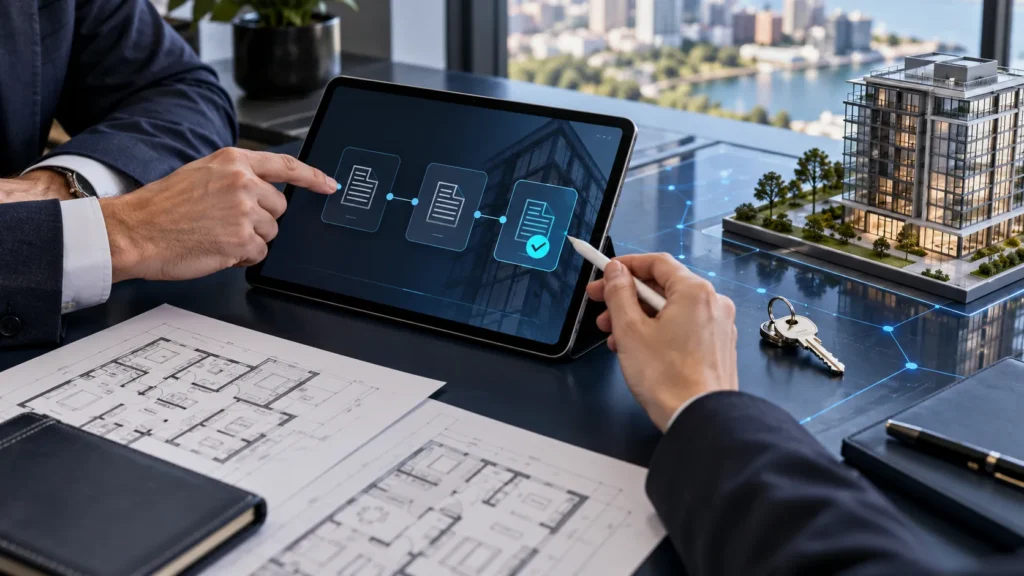
Beyond the Hype: How Blockchain Is Rewiring Real Estate in 2026
Blockchain is not replacing real estate in 2026. It is replacing the paperwork, the settlement lag and the minimum ticket size that sit around it. The measurable wins this year are in land records and in regulated, fractional property securities. The “trillions on-chain” headlines are still mostly forecasts.
If you design power systems for hyperscale campuses, ship smart contracts, build AI models or run pharma R&D facilities, this matters to you. Your work increasingly lives inside specialised buildings, and those buildings are where on-chain ownership and financing are being tested first. Here is a practitioner’s view of what is real, what is hype, and how the US and Australia differ.
1. Tokenization: fractional ownership, honestly measured
Tokenization turns an economic interest in a property into a digital token that can be issued, transferred and paid out programmatically. The token does not hold the title itself. Title stays with a legal wrapper, usually an SPV, LLC or unit trust, and the token represents a share of that wrapper.
A typical compliant stack looks like this:
- Asset: a building, a portfolio or a loan secured on property.
- Legal wrapper: an SPV or trust holds title under ordinary property law.
- Security token: issued on a public or permissioned chain, often using a permissioned standard such as ERC-3643, which enforces KYC’d wallets and transfer rules in the contract itself.
- Investor onboarding: KYC/AML, accreditation checks where required, whitelisted wallets.
- Servicing: rent or interest distributed automatically, often in stablecoins, with cap-table updates on-chain.
- Secondary transfer: peer-to-peer between eligible wallets, or on a licensed trading venue.
How big is it really? Forecasts are huge: Deloitte has projected a roughly $4 trillion tokenized real estate market by 2035. The live numbers are much smaller. According to RWA.xyz data as of 27 July 2026, “distributed” tokenized real estate, meaning tokens that move freely between eligible wallets, was about US$203 million. That sits inside roughly US$36.9 billion of distributed real-world assets overall, which is dominated by tokenized Treasuries and private credit. Far larger sums are “represented” on closed platforms that use a ledger internally but do not let tokens circulate.

That gap is the story for an expert audience. Property is the hardest asset to put on-chain because it needs appraisals, tax treatment, insurance, maintenance and title work that a smart contract cannot do on its own.
2. Title, escrow and settlement: the quieter, bigger win
The most concrete progress is not in trading. It is in public land records. In most US counties a deed is still delivered, scanned and indexed by hand, and errors in that chain are the reason title insurance exists.
- Bergen County, New Jersey: the County Clerk signed a five-year deal with Balcony to tokenize about 370,000 deeds, representing roughly $240 billion of property, on the Avalanche blockchain. It covers all 70 municipalities and is billed as the largest deed-tokenization project in US history. Balcony claims deed processing time drops by more than 90%.
- Maryland: Senate Bill 168, signed in May 2026, sets up a Blockchain-Based Real Property Title Pilot Program within the State Department of Assessments and Taxation. Its focus includes verifying ownership and helping courts resolve disputes such as squatting.
- Earlier pilots: Cook County, Illinois (2016) and South Burlington, Vermont (2018) proved the concept on a small scale.
On the private side, platforms such as Propy run title and escrow workflows on smart contracts. Funds are released only when conditions are met, and every step leaves an auditable trail. For a buyer this means fewer wire-fraud windows and faster closings. For a lender it means a cleaner, machine-readable chain of title.
The engineering caveat: a blockchain only guarantees that a record has not changed since it was written. It does not guarantee the record was correct when it went in. Identity, notarisation and the legal status of the on-chain record still decide whether a token is the title or only mirrors it.
3. United States: a token is still a security
The SEC’s message has been consistent: putting a security on a blockchain does not change what it is. Key 2025–26 milestones:
| Date | Action | What it means for property tokens |
|---|---|---|
| 17 Sep 2026 | Temporary conditional relief for permissioned trading of tokenized NMS stock | Covers listed stocks only, not private real estate tokens |
| 21 Aug 2026 | Proposed Regulation Crypto Assets (comments closed 20 Oct 2026) | Points other securities back to Regulation D and Regulation A |
| 28 Jan 2026 | Staff statement on tokenized securities | The token format does not alter how securities law applies |
| 9 Jul 2025 | Commissioner Peirce statement | “Tokenized securities are still securities” |
In practice, US property tokens are sold under the same exemptions as any private real estate deal. Rule 506(c) under Regulation D, limited to accredited investors, is the most common route. Regulation A+ and Regulation Crowdfunding open the door to retail investors, with caps and disclosure costs.
The filing record is sobering. A review of EDGAR found 44 filers tied to tokenized real estate as of 10 October 2026, and only 5 filed anything in 2026. Seventeen RealToken entities together reported $110,447 sold in their Form D filings. Retail tokenized property has been slower and smaller than its marketing suggested; institutional and public-records use cases are where momentum is.
4. Australia: a licensing regime is on the way
Australia treats most tokenized property the way it treats a property fund. Depending on structure, a token offering is likely to be a financial product and often a managed investment scheme (MIS) under the Corporations Act 2001. That means an Australian Financial Services Licence (AFSL), a responsible entity and disclosure obligations, whatever chain sits underneath.
The regulatory timeline is moving quickly:
- ASIC INFO 225 (updated): added 18 worked classification examples, including tokenized real estate, and gave the sector a no-action position until 30 June 2026 to get licensed.
- Corporations Amendment (Digital Assets Framework) Act 2026: creates a dedicated regime for digital-asset platforms and tokenised-custody platforms, scheduled to commence on 9 April 2027.
- Project Acacia: the Reserve Bank of Australia and the Digital Finance CRC reported in May 2026 that tokenized wholesale settlement showed faster settlement, lower counterparty risk and automated asset servicing.
- Trading venues: BTC Markets told ASIC in March 2026 that it intends to apply for a markets licence to trade tokenized real-world assets.
Alongside this, the AML/CTF “Tranche 2” reforms are bringing real estate agents into AUSTRAC’s reporting regime. On-chain KYC and auditable transaction trails are a natural fit for those obligations.
For Australian readers the takeaway is simple. Tokenization of property is legal today if it is structured as a regulated financial product. After April 2027, platform and custody rules become explicit.
5. Why this matters to your field
Data center and electrical engineers. Data centers are now a real estate class in their own right, and power is the binding constraint. BDO cites a projection that AI data center energy use will grow about 43% a year through 2029. Capital is already experimenting with on-chain structures here: Aurum Equity Partners announced a $1 billion tokenized equity-and-debt fund for data centers on the XRP Ledger. The interesting engineering question is what gets tokenized next. Power purchase agreements, substation capacity, MW-denominated leases and metered energy data are all candidates. Your SCADA and metering data may become the oracle feed that values the asset.
Blockchain engineers. The hard problems are no longer minting tokens. They are permissioned transfer logic (ERC-3643 and similar), oracle design for valuations and rent rolls, cross-chain identity, and interoperability with legacy registries such as county recorders. Bergen County running on Avalanche shows that public chains can serve government workloads when access is controlled at the application layer.
Crypto investors. Tokenized property is a yield-bearing real-world asset, not a speculative coin. Expect KYC gates, transfer restrictions and thin secondary markets. Stablecoin rails for rent distribution are where crypto infrastructure adds the most practical value.
AI practitioners. Tokenization creates clean, structured, time-stamped data: ownership, cash flows, maintenance events. That is exactly what automated valuation models, risk engines and AI-driven property management need. AI agents can also run compliance checks and investor reporting against on-chain state.
Pharmaceutical and life-science professionals. Labs, cleanrooms, GMP manufacturing sites and cold-chain warehouses are specialised, capital-heavy property. Fractional ownership and on-chain lease and maintenance records can broaden the investor base for these facilities. Immutable audit trails for building systems also echo the data-integrity discipline (ALCOA+) that pharma quality teams already apply.
6. The risks experts should not skip
- Liquidity is promised more than delivered. A token can be transferable and still have no buyers. Secondary venues remain few and licensed ones fewer.
- The oracle problem. On-chain records are only as good as the off-chain inputs: appraisals, rent data, title searches.
- Legal finality. In most jurisdictions the county register or state land titles office, not the chain, is the source of truth. If the two disagree, the court follows the register.
- Smart contract and custody risk. Bugs, lost keys and compromised admin keys can freeze or misdirect assets. Permissioned standards add recovery paths but also central control points.
- Regulatory divergence. A structure compliant in New South Wales may be an unregistered offering in New York. Cross-border tokens multiply that problem.
- Platform failure. If the operator of the SPV or platform fails, investors depend on the legal wrapper, not the token, to recover value.
Conclusion: infrastructure first, hype last
Blockchain’s real contribution to real estate in 2026 is plumbing: tamper-evident land records, programmable escrow, automated distributions and compliance built into the asset itself. Bergen County, Maryland and Australia’s Project Acacia show governments and central banks treating it as infrastructure.
The next phase will be decided by regulation and by specialised assets. Data centers, labs and energy-linked property have high values, institutional owners and rich operating data, which makes them the most natural fit for on-chain ownership. For engineers and technologists in these fields, the opportunity is to help build the rails rather than wait for them.
Articles are shared for information and discussion. Nothing here is financial or investment advice.